The 1920’s Men’s Fashion didn’t just change music and culture it rewired how men thought about clothing. After World War I, a generation of young men returned home restless and hungry for something new. The stiff Victorian formality their fathers wore felt like a relic. What replaced it was sharper, looser, and surprisingly modern.
If you’re here to understand the era for a costume, a period drama, a fashion history project, or just genuine curiosity, this guide covers the real details not just “men wore suits and fedoras.”
The Social Context That Shaped 1920’s Menswear
You can’t separate 1920s fashion from its historical moment. Prohibition, jazz clubs, economic boom, and the rise of Hollywood all had direct influence on what men wore and how they wore it.
The working class had more disposable income than previous generations. Ready-to-wear clothing became more accessible. Department stores expanded. Men who couldn’t afford a Savile Row tailor could still look sharp by the standards of the day.
Jazz culture, centered in Harlem and Chicago, pushed certain aesthetics ,wide-legged trousers, bold accessories, and an effortless confidence in how clothing was worn. The Ivy League universities simultaneously pushed a more restrained, preppy silhouette. Both threads ran through the decade at the same time, which is why 1920s men’s fashion isn’t a single look , it’s several competing ones.
The Core Silhouette: What Actually Changed
Before the 1920s, men’s suits were structured, heavily padded, and stiff through the shoulders. The 1920s loosened everything.
The defining shift was the lounge suit becoming everyday wear. Jackets became slightly longer, with a softer shoulder and a more natural chest line. Trousers widened through the leg , the extreme version was Oxford Bags, which became a campus craze in Britain around 1924–1925, with leg widths reportedly reaching 24 to 40 inches at the hem. Most men didn’t go that far, but wider trousers than the Edwardian norm were universal.
Single-breasted jackets with two or three buttons were standard. Double-breasted styles existed but were less common for casual wear. Lapels were wide and flat , notch lapels dominated, with peak lapels reserved for more formal or evening wear.
Waistcoats (vests) were still part of the three-piece suit throughout the decade, though younger men began skipping them toward the late 1920s, which felt daring at the time.
Key Garments and How They Were Actually Worn
The Suit
The lounge suit was the backbone of the decade. Wool was the dominant fabric , flannel for casual, worsted for business. Earth tones, grey, navy, and cream were the standard palette. Pinstripes and chalk stripes appeared in the mid-decade, partly popularized by the Prince of Wales (later Edward VIII), who was genuinely one of the most influential men’s style figures of the era.
Suits weren’t worn casually the way people sometimes assume from movies. Even a relatively informal outing warranted a jacket. The distinction wasn’t suited vs. unsaited , it was the type of suit and accessories that signaled formality level.
Oxford Bags and Plus Fours
Plus Fours were knickerbockers that extended four inches below the knee. They were a golf and country staple from around 1920 onward. Worn with argyle or Fair Isle patterned knee socks, two-tone brogues, and a cable-knit sweater, this was the weekend sportswear look for upper and middle-class men.
Oxford Bags were the exaggerated wide-legged trousers associated with university students. They were almost a protest garment ,deliberately oversized as a rejection of formality. If you see a costume from the 1920s with comically wide trousers, that’s the Oxford Bags reference.
The Overcoat
The Chesterfield coat , a formal, knee-length overcoat with a fly front and velvet collar ,was the smart outerwear choice. For less formal situations, the raglan-sleeve overcoat or the belted trench coat (which carried over from military use in WWI) were common. The polo coat, made of camel-colored wool, became popular by the late 1920s as American collegiate fashion picked it up.
Eveningwear
White tie (tailcoat, white waistcoat, white bow tie) was still the expected dress for formal dinners and balls. Black tie — the dinner jacket or tuxedo — was increasingly accepted for semi-formal evening events, though traditionalists resisted it as too casual. This tension between white tie and black tie was a genuine cultural debate in the 1920s, not just a footnote.
Accessories: Where the Personality Came Through
This is where most costume guides fall short. The suit was relatively standardized ,accessories were where individual style lived.
Hats were non-negotiable. The fedora (soft felt, creased crown, brim turned down at front) was the most versatile option. The homburg was slightly more formal. The flat cap or newsboy cap was working-class and casual. The boater straw hat was summer and seaside. Going hatless in public was still unusual until the very end of the decade.
Collar and tie combinations were carefully considered. Detachable stiff collars were giving way to attached soft collars through the decade , this was a genuine fashion shift that men debated. Tie widths were medium, knots were small (four-in-hand). Bow ties appeared at formal occasions. Collar bars and tie pins were common accessories.
Pocket squares were used, but the rules were more relaxed than the Edwardian era. A simple white linen square in the breast pocket was standard. More casual folded or puffed squares appeared toward the late 1920s.
Shoes tell you a lot about the decade. Two-tone brogues (often white and tan or black and white) were fashionable for casual and sporting wear. Oxford shoes in black or brown leather were the default business shoe. Spats , those cloth covers over the ankle and shoe ,were still worn by fashion-conscious men early in the decade but became increasingly old-fashioned as the 1920s progressed.
Wristwatches made their mainstream entry into men’s fashion during this era. Pocket watches were still used, but wristwatches , practical from WWI military use became acceptable for civilian life. Rectangular cases were fashionable alongside round ones.
The Harlem Renaissance Influence
Any honest account of 1920s men’s fashion has to include Harlem. The jazz age aesthetic particularly among Black American men in cities like New York and Chicago pushed a sharp, expressive style that the mainstream fashion press largely ignored at the time but absolutely absorbed.
The “sharp dresser” ideal in this community meant perfectly fitted suits, bold printed ties, two-tone shoes, and wide-brimmed hats worn with confidence. This aesthetic fed directly into what would later be called the “zoot suit” style in the 1930s and 1940s. The roots are firmly in 1920s Harlem.
Magazines like The Crisis (founded by W.E.B. Du Bois in 1910) documented this culture with a seriousness and specificity that fashion histories often overlook.
Common Misconceptions About 1920s Men’s Fashion
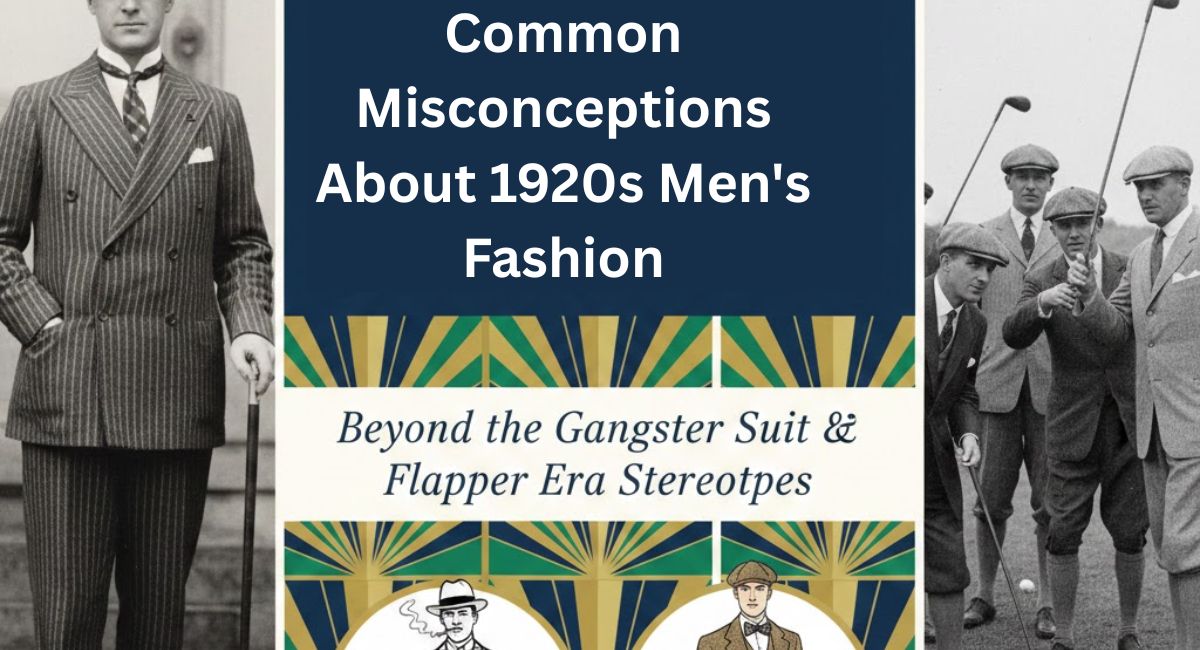
“Men only wore black and white.” Silent film creates this impression because black-and-white photography dominated. In reality, the 1920s were full of color tan and cream suits for summer, burgundy ties, blue and green argyle patterns, rust-brown overcoats.
“The look was uniform.” There were clear class, regional, and subcultural differences. A Scottish golf enthusiast, a Harlem jazz musician, a London banker, and a Chicago bootlegger all dressed within the era but looked very different.
“It was all about excess.” This is the Great Gatsby effect. Most men dressed practically and conservatively within the era’s norms. The extravagant party clothes in the novel represented extreme wealth, not typical 1920s dress.
How to Recreate the Look Today
For costume or genuine style inspiration, the priorities are:
- A two or three-button suit with natural shoulders and wider-leg trousers
- A felt fedora or flat cap depending on formality level
- Two-tone Oxford or brogue shoes
- A small-knot tie in a solid, stripe, or small geometric pattern
- A white dress shirt with a spread or point collar
Avoid modern slim-cut suits — the silhouette is wrong. Look for suits described as “relaxed fit” or “classic fit.” Vintage stores and reproduction menswear brands like Blackbird Fabrics or period costume suppliers will have more accurate options than mainstream retailers.
FAQs About 1920s Men’s Fashion
Did all men wear fedoras in the 1920s? Hats were nearly universal for men in public during this era, but the type varied by class and occasion. Fedoras were popular mid-decade, but flat caps, boaters, and homburgs were equally common depending on context. No single hat defines the decade for all men.
What were Oxford Bags, and did regular men actually wear them? Oxford Bags were extremely wide-legged trousers that became a collegiate fashion trend around 1924–1925, primarily in British universities. Regular working men didn’t wear them — they were associated with university students and upper-class young men making a deliberate style statement.
Was the three-piece suit standard throughout the 1920s? Yes, the three-piece suit (jacket, trousers, waistcoat) remained standard, especially for business and formal wear. The trend away from the waistcoat only began toward the very end of the decade among younger, more fashion-forward men.
How did working-class men dress differently from the wealthy? Working-class men wore simpler, more durable fabrics — wool blends rather than fine worsted, flat caps rather than fedoras, and fewer accessories. The suit was still common, but fit and fabric quality varied significantly. The silhouette was similar; the materials and details were different.
Where can I find accurate 1920s menswear for a costume or event? Vintage stores, theatrical costume suppliers, and online reproduction clothing brands are your best options. Search specifically for “1920s lounge suit reproduction” or “period correct 1920s menswear.” Major retailers rarely carry the correct silhouette — the trouser width alone disqualifies most modern suits.
Conclusion
The 1920s produced a men’s fashion moment that was genuinely transitional looser than what came before, more formal than what came after, and full of internal contradictions between tradition and modernity. Understanding the decade means getting past the Gatsby caricature and into the real texture of what different men, in different places and social positions, actually wore.
The silhouette, the accessories, and the social context all connect. Get those three right, and you’ll have a much richer understanding of why 1920s men’s fashion still influences designers, costumers, and style enthusiasts today.